

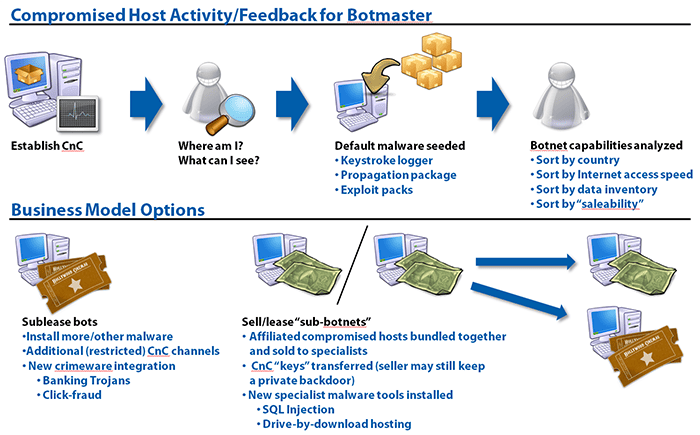
The monetizing stage of a botnet is vast and quite often the main purpose of why a botnet was started in the first place, the list is not exhaustible and new methods/ideas are being used each year, as you may read in bot-related articles.
Some examples of the monetizing process are:
Web Injects/Keylogging –
Stealing information for specific websites, or stealing every keystroke/cache it can. While you may think not much can be brought of this, ZeuS, SpyEye, and other various ‘carding’ bots have proven this to be beneficial to the bot herder/criminal rings involved. Credit card and bank information, if coupled with the people who have the know-how and the correct connections, leads to easy retirement (or easy jail sentence).
DDoS –
Botnets are often made specifically for power, the DDoS module of a botnet can actually be utilized for monetizing through extortion (You don’t pay, we bring your site down) where many small companies would laugh this threat off, larger companies dependant on their internet services would most likely co-operate. You may sell your DDoS Services.
Spam –
Botnets can be used to generate a large number of efficient spam (I say efficient because there is no centralized SMTP server) and subsequently, generate traffic to various web stores; usually advertising goods such as viagra, etc.
Ransomware –
Ransomware can hold the system’s files at ransom by encrypting the files with 256bit encryption (or similar) RSA and asking for a specific sum of money for the release of these files.
Scareware –
In a similar fashion, scareware will socially engineer the victim to enter credit card details and purchase a ‘fix’ for a virus present on their system.
Blackhat SEO/Generating web traffic –
A website with the correct metadata can be boosted up in the Google rankings if the web traffic of thousands of bots visits the website – using Botnets for SEO purposes is a great way of monetizing.
These are just some examples of the methods employed by bot herders, I can think of a few more on the spot and a lot more eventually – but this is just to give you an insight on what is currently possible/happening… ;)
Ad clicking is one method similar to the blackhat SEO technique, most of them actually use the same type of bots with the same functions.
The bot herder would issue a command like: “.visit http://www.google.com“
The period is the command prefix (to introduce a command)
“visit” being the command name
http://www.google.com is the desired website to visit.
Additionally, some bots allow the user to choose whether to visit the website without showing a browser (so the victim doesn’t notice) and others specifically open the website in a browser. This is how a lot of system pop-ups are opened (those that appear without visiting websites in the first place). These pay-per-click schemes generally do not develop a large income, and if they do – is usually a small one-time burst, rather than a long-term income. Not something to really consider if you aim to start a botnet in the first place.
Similar to the pay-per-visit campaigns available, there is also PPI (pay per install) where a bot herder can install a software application (usually adware) and receive a payment in return for each bot (say $0.50), obviously, over a large number of bots – this can accumulate a lot, not to mention selling these bots to multiple software vendors. Problems exist with these methods, however, as a lot of these PPI companies ‘shave’ the bots, meaning that they will claim only 1/2 of the bots actually successfully installed the application or they go to the extent of attempting to botkill the bots, removing the bots from the seller’s botnet. Many of these companies are closed within the first few months of operation, but some more ‘legitimate’ schemes exist that specify not to install the software on systems without the owner’s permission.
Bitcoin Mining –
Well, this is something new these days and would be really beneficial to earn a lot if you are into Bitcoin. Won’t go deep into this though.
Remember, the methods that exist today and the ones listed above are all ‘the main methods’ but of course, the ones that will make the most money are the zero-days. Basically coming up with your own way of making money (and incorporating this into your botnet source) is the way to victory. Think of an action that can make you a small amount of money, if you sat doing it hour after hour, day after day would fetch you a lot of money – that may be your key.
Botnets can offer distributed automation of a process, and many bot makers use this to their advantage.
Source: http://board.th3-0utl4ws.com/showthread.php?p=34732


