


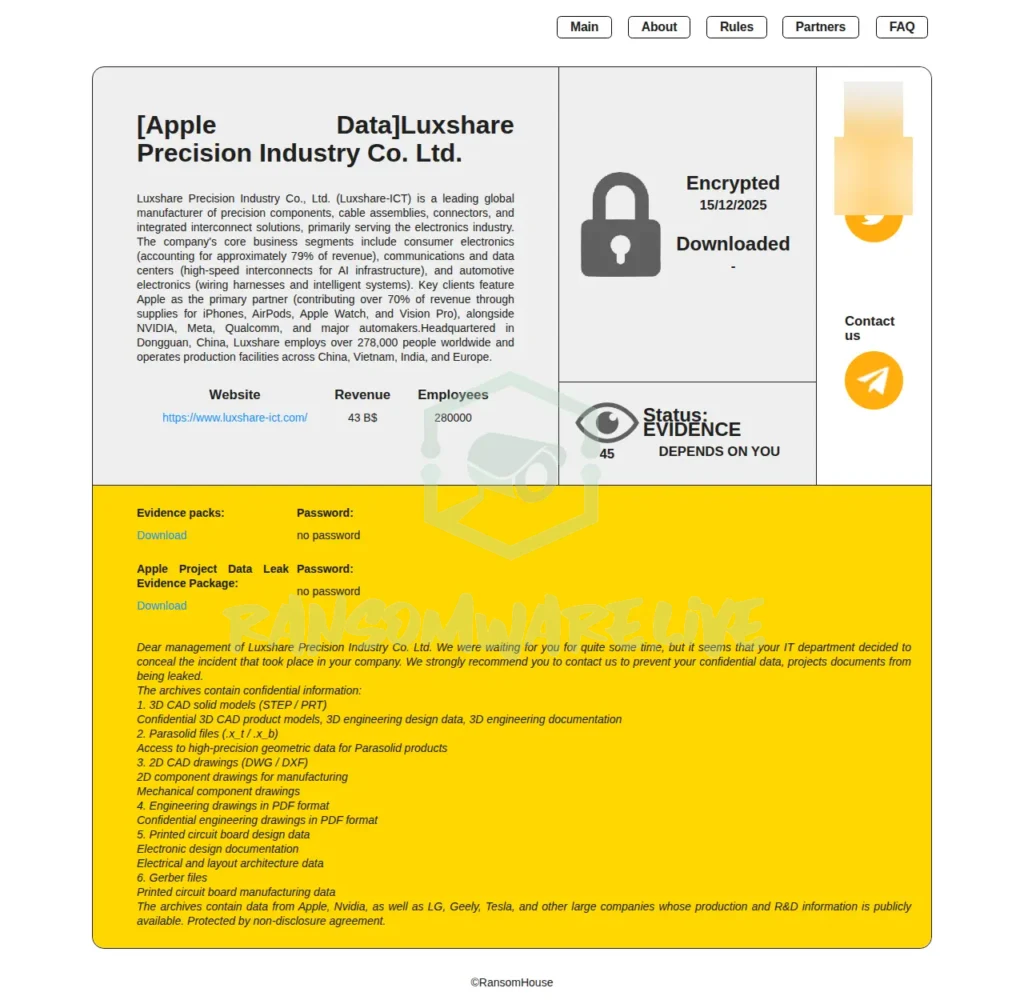
RansomHouse, a notorious ransomware and data extortion group, has claimed responsibility for a significant cyberattack on Luxshare Precision Industry Co. Ltd., a primary manufacturing partner for Apple Inc. The attackers allege they have stolen sensitive intellectual property, including technical schematics and product designs.
The Claim
The group posted the claim to its dark web leak site earlier this week. RansomHouse asserts it has exfiltrated a trove of confidential engineering data, specifically listing:
- 3D CAD models
- Printed Circuit Board (PCB) design files
- Internal project documentation
- Schematics related to Apple and Nvidia products
The group initially listed links purportedly containing evidence packs and project data, though monitoring services indicate these access points are currently unstable. No verifiable sample data has been widely released to substantiate the group’s claims as of this morning. The leak site currently displays a message reading “Depends on you,” suggesting that ransom negotiations may be active or attempted.
The Target: A Critical Supply Chain Node
Luxshare Precision Industry, based in Dongguan, China, is a linchpin in the global electronics supply chain. The company is best known as a key assembler for Apple, responsible for manufacturing major product lines including the iPhone, Apple Watch, AirPods, and the Vision Pro headset.
Industry data indicates that Apple accounts for more than 70% of Luxshare’s revenue. The manufacturer also serves other tech giants such as Nvidia, Meta, and Qualcomm, making a potential breach a high-stakes security incident for multiple major stakeholders.
Implications for Information Security
If confirmed, this breach highlights the persistent danger of third-party supply chain attacks. For information security professionals, the incident underscores several critical risks:
- Intellectual Property Theft: The exposure of CAD and PCB files could allow competitors or counterfeiters to replicate proprietary hardware designs.
- Hardware Vulnerabilities: Detailed schematics could theoretically aid researchers—or malicious actors—in discovering hardware-level exploits in consumer devices.
- Supplier Dependency: The concentration of manufacturing data in a single vendor creates a high-value target for extortion groups.
Current Status and Response
Neither Luxshare nor Apple has issued an official statement confirming the incident. The current status of Luxshare’s operational systems remains unclear, though the attackers claim to have encrypted files earlier this month.
Recommended Actions
Security teams at organizations with dependencies on Luxshare or similar manufacturing partners should heighten vigilance.
- Monitor Threat Intelligence: Watch for leaked credentials or data dumps associated with the vendor.
- Review Supplier Risk: Re-evaluate data sharing protocols with external manufacturers.
- Verify Communications: Ensure that any communication appearing to come from the affected vendor is authenticated to prevent secondary phishing attacks.
This is a developing story. ZeroSecurity will provide updates as more information becomes available.


