

ZeroSecurity - Information Security News
  • Home
  • Security
    • Exploits
    • Mobile Security
  • Malware
  • Breaches
  • Crypto
  • Privacy
  • Tech
    • AI
    • Downloads
      • Malwarebytes
      • Exploits
      • Paper Downloads
    • Reviews
No Result
View All Result
SUBSCRIBE
ZeroSecurity - Information Security News
  • Home
  • Security
    • Exploits
    • Mobile Security
  • Malware
  • Breaches
  • Crypto
  • Privacy
  • Tech
    • AI
    • Downloads
      • Malwarebytes
      • Exploits
      • Paper Downloads
    • Reviews
No Result
View All Result
ZeroSecurity - Information Security News
No Result
View All Result
Home Malware

Hummer malware infecting androids earns $3.5 Million a week

Paul by Paul
July 6, 2016 - Updated on May 17, 2022
in Malware, Mobile Security, Public, Security
Reading Time: 2 mins read
hummer malware infections
Share on FacebookShare on Twitter

A new Trojan, named Hummer, has been discovered infecting Android phones. The malware creators are earning an estimated $3,500,000 a week or $500,000 a day say researchers at Cheetah Mobile Security Lab in a blog post.

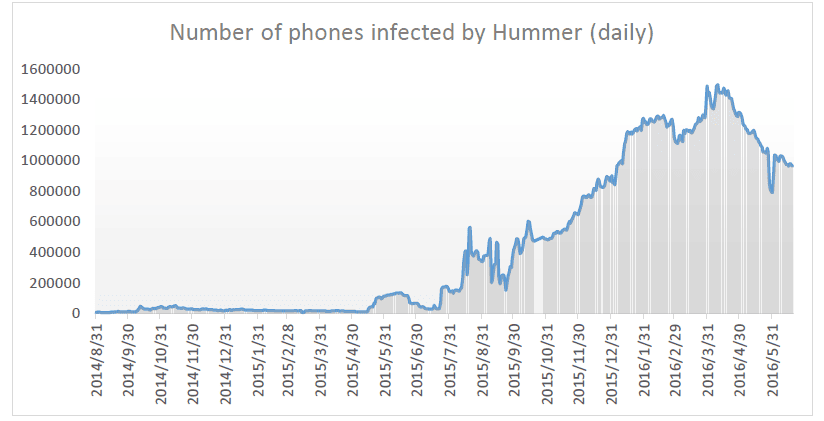
In an alert given Wednesday, analysts claimed that at its peak, Hummer infected about 1.4 million Androids daily with 63,000 infections occurring everyday in Asia. This trojan variant, considered to be among the most prominent ever, may be linked somehow to “the underground industry chain in China.”

If Hummer’s makers generate 50 cents every time the virus is installed on a smartphone app, they can expect to easily earn half a million dollars.

When a phone is infected, Hummer auto-roots it to achieve admin privileges, which makes it hard if not impossible for conventional anti-virus tools to eliminate it. All members of the trojan family are integrated with a root module while the Hummer variant includes up to 18 different root techniques, the researchers stated.

Beginning in early 2016, the team behind the Hummer malware began to use 12 domain names, a number of them associated with an email in mainland China, to upgrade Hummer and release promotion orders Cheatah Mobile stated.

“The researchers believe that this trojan family originated from the underground internet industry chain in China, based on the trojan codes that have been uploaded to an open-source platform by a careless member of the criminal group behind the trojan family,” as stated by the blog, which mentioned that the volume of phones being infected with Hummer is far beyond any other mobile phone malware.

It also might be the most bothersome. “This trojan continually pops up ads on victims’ phones, which is extremely annoying. It also pushes mobile phone games and silently installs porn applications in the background,” “Unwanted apps appear on these devices, and they’re reinstalled shortly after users uninstall them.”

You might also like

Hackers Exploit Maximum-Severity Cisco Zero-Day Bug Since 2023 (CVE-2026-20127)

How Hackers Still Manage to Compromise MFA

Anthropic Unveils Claude Code Security to Detect and Fix Critical Vulnerabilities

In a experiment performed by Cheetah, “the trojan accessed the network over 10,000 times and downloaded over 200 APKs, consuming 2 GB of network traffic,” tasks which the experts said was “astonishing.”

Removing the Hummer Malware

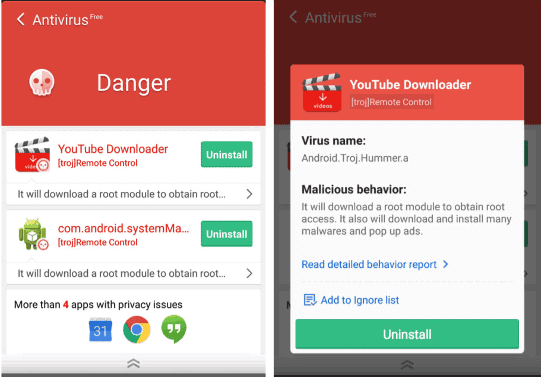
Cheetah has updated their Trojan Killer app to effectively remove the Hummer malware, and it’s available on the Google Play store for all android devices, here.

Hummer malware removal
Hummer malware removal tool by Cheetah Mobile
Tags: androidHummermalware
Previous Post

Clinton pledges to grow the technology sector

Next Post

EasyDoc malware infects Macs and routes through TOR

Paul

Paul

Editor and chief at ZeroSecurity. Expertise includes programming, malware analysis, and penetration testing. If you would like to write for ZeroSecurity, please click "Contact us" at the bottom of the page.

Recommended For You

Photo of the CISCO logo and text saying "You have been hacked!"

Hackers Exploit Maximum-Severity Cisco Zero-Day Bug Since 2023 (CVE-2026-20127)

March 6, 2026
How Hackers Still Manage to Compromise MFA

How Hackers Still Manage to Compromise MFA

March 6, 2026

Anthropic Unveils Claude Code Security to Detect and Fix Critical Vulnerabilities

February 22, 2026

Chinese Hackers Hijack Notepad++ Updates in 6-Month Supply Chain Campaign

February 6, 2026

Malicious Chrome Extensions Steal AI Data and Hijack Revenue in DarkSpectre Campaign

January 30, 2026

Phishing 2.0: How AI is Turning Cyber Attacks into a Science

January 7, 2025 - Updated on January 9, 2025

Related News

Malicious Chrome Extensions Steal AI Data and Hijack Revenue in DarkSpectre Campaign

Malicious Chrome Extensions Steal AI Data and Hijack Revenue in DarkSpectre Campaign

January 30, 2026
KPMG Netherlands Listed as Victim by Nova Ransomware Group

KPMG Netherlands Listed as Victim by Nova Ransomware Group

January 24, 2026
RansomHouse Claims Breach of Key Apple Assembler Luxshare

RansomHouse Claims Breach of Key Apple Assembler Luxshare

January 20, 2026
ZeroSecurity - Information Security News

We cover the latest in technology news, Crypto, Artificial Intelligence, and the threat trends impacting these sectors.

Categories

Piracy

Tutorials

Programming

Malware Analysis

Downloads

  • Contact us
  • Press
  • Writers
  • Privacy Policy
  • Terms of Service

© 2026 ZeroSecurity, All Rights Reserved.

No Result
View All Result
  • Home
  • Security
    • Tools
  • Exploits
  • Data Breaches
  • Malware
  • Privacy
  • Mobile Security
  • Contact Us
    • Press
  • Privacy Policy

© 2026 ZeroSecurity, All Rights Reserved.

This website uses cookies. By continuing to use this website you are giving consent to cookies being used. Visit our Privacy and Cookie Policy.