

ZeroSecurity - Information Security News
  • Home
  • Security
    • Exploits
    • Mobile Security
  • Malware
  • Breaches
  • Crypto
  • Privacy
  • Tech
    • AI
    • Downloads
      • Malwarebytes
      • Exploits
      • Paper Downloads
    • Reviews
No Result
View All Result
SUBSCRIBE
ZeroSecurity - Information Security News
  • Home
  • Security
    • Exploits
    • Mobile Security
  • Malware
  • Breaches
  • Crypto
  • Privacy
  • Tech
    • AI
    • Downloads
      • Malwarebytes
      • Exploits
      • Paper Downloads
    • Reviews
No Result
View All Result
ZeroSecurity - Information Security News
No Result
View All Result
Home Exploits

Google Introduces V8 Sandbox to Tackle Memory Corruption in Chrome

Kyle by Kyle
April 9, 2024 - Updated on April 10, 2024
in Exploits
Reading Time: 2 mins read
google chrome memory corruption sandbox v8
Share on FacebookShare on Twitter

Google has announced a new security feature called the V8 Sandbox for its Chrome web browser. This move aims to address the persistent issue of memory corruption vulnerabilities in the V8 JavaScript and WebAssembly engine.

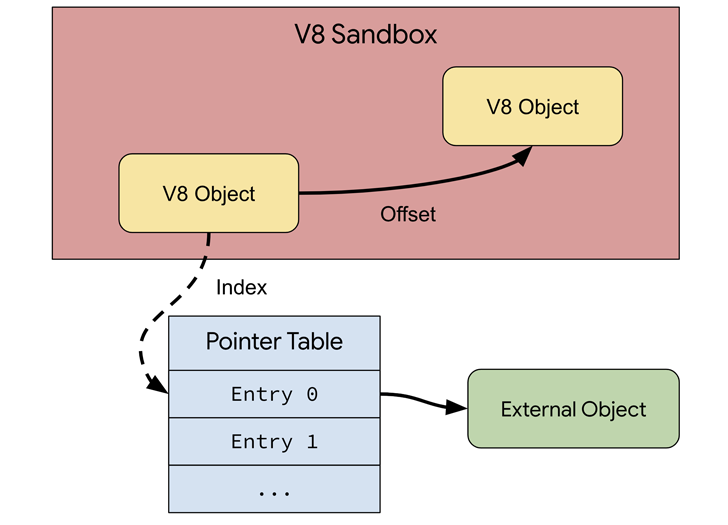
According to Samuel Groß, the technical lead for V8 Security, the sandbox is designed to prevent “memory corruption in V8 from spreading within the host process.” In other words, it aims to isolate the impact of V8 vulnerabilities by restricting the code executed by V8 to a specific virtual address space, effectively containing any potential damage.

A Specialized Solution for Vulnerabilities

Google has described the V8 Sandbox as a lightweight, in-process solution that is tailored to mitigate common V8-related vulnerabilities. The rationale behind this approach is that while typical memory-corruption bugs can be addressed using techniques like memory safety, the “subtle logic issues” that plague V8 require a more specialized solution.
You might also like

Hackers Exploit Maximum-Severity Cisco Zero-Day Bug Since 2023 (CVE-2026-20127)

DoubleClickjacking – The Stealthy New Web Exploit Threatening User Security

Critical Vulnerabilities Exposed in Ruijie Networks Cloud Platform

Google Chrome V8

Containing Memory Corruption Within the Sandbox

Assumptions and Protective Measures

The Chromium team explained that the sandbox assumes an attacker can arbitrarily modify any memory within the sandbox, and can also read memory outside of it. The sandbox, therefore, aims to protect the rest of the process from such an attacker, ensuring that any memory corruption is confined within the sandbox.

Addressing the Challenges of V8 Vulnerabilities

Interestingly, Groß highlighted the challenges of addressing V8 vulnerabilities by switching to a memory-safe language like Rust or relying on hardware-based memory safety approaches. He noted that nearly all V8 vulnerabilities involve memory corruption within the V8 heap, which cannot be adequately protected by traditional techniques.

To mitigate this, the V8 Sandbox replaces data types that can access out-of-sandbox memory with “sandbox-compatible” alternatives, effectively preventing an attacker from accessing other parts of the process’ memory. Benchmark results indicate that the V8 Sandbox adds an overhead of around 1% on typical workloads, allowing it to be enabled by default starting with Chrome version 123, across various platforms. However, the sandbox does require a 64-bit system due to its need for a large virtual address space.

Complementary Security Efforts

The announcement also mentioned Google’s use of Kernel Address Sanitizer (KASan) to detect memory bugs in native code and harden Android firmware security, with the tool helping to uncover more than 40 bugs.

“Using KASan-enabled builds during testing and/or fuzzing can help catch memory corruption vulnerabilities and stability issues before they land on user devices,” the Android team said.

Previous Post

China and North Korea Intensify Cyber Campaigns with AI Assistance

Next Post

Multiple Security Vulnerabilities Discovered in LG webOS Powering Smart TVs

Kyle

Kyle

Writer, and editor at ZeroSecurity. Interested in Information Security, the Blockchain, and an overall tech enthusiast. "Formal education will make you a living; self-education will make you a fortune." Contact me here: [email protected]

Recommended For You

Photo of the CISCO logo and text saying "You have been hacked!"

Hackers Exploit Maximum-Severity Cisco Zero-Day Bug Since 2023 (CVE-2026-20127)

March 6, 2026
What is DoubleClickJacking?

DoubleClickjacking – The Stealthy New Web Exploit Threatening User Security

January 1, 2025

Critical Vulnerabilities Exposed in Ruijie Networks Cloud Platform

December 25, 2024

Vulnerability (CVE-2024-54143 ) Discovered in OpenWrt’s Firmware Upgrade System

December 13, 2024

Cybercriminals Unleash Advanced Phishing-as-a-Service Toolkit Targeting Microsoft 365 Users

November 29, 2024

Major Security Vulnerability Uncovered in qBittorrent Client

November 1, 2024

Related News

Malicious Chrome Extensions Steal AI Data and Hijack Revenue in DarkSpectre Campaign

Malicious Chrome Extensions Steal AI Data and Hijack Revenue in DarkSpectre Campaign

January 30, 2026
KPMG Netherlands Listed as Victim by Nova Ransomware Group

KPMG Netherlands Listed as Victim by Nova Ransomware Group

January 24, 2026
RansomHouse Claims Breach of Key Apple Assembler Luxshare

RansomHouse Claims Breach of Key Apple Assembler Luxshare

January 20, 2026
ZeroSecurity - Information Security News

We cover the latest in technology news, Crypto, Artificial Intelligence, and the threat trends impacting these sectors.

Categories

Piracy

Tutorials

Programming

Malware Analysis

Downloads

  • Contact us
  • Press
  • Writers
  • Privacy Policy
  • Terms of Service

© 2026 ZeroSecurity, All Rights Reserved.

No Result
View All Result
  • Home
  • Security
    • Tools
  • Exploits
  • Data Breaches
  • Malware
  • Privacy
  • Mobile Security
  • Contact Us
    • Press
  • Privacy Policy

© 2026 ZeroSecurity, All Rights Reserved.

This website uses cookies. By continuing to use this website you are giving consent to cookies being used. Visit our Privacy and Cookie Policy.